

diagnosis
Home Sleep Test Singapore: What Actually Happens on the Night

Your partner has been telling you for years. You wake up tired no matter how early you go to bed. Somebody finally said the words "sleep apnoea", and now there is a test you are supposed to book.
A home sleep test in Singapore means sleeping one night in your own bed with a small recorder and a few soft sensors on your body. No hospital, no overnight stay, no stranger watching you. You sleep, the device records your breathing through the night, and a physician reviews what it captured.
I am Jo Ng, a Registered Polysomnographic Technologist. I have set sensors on a lot of nervous people, and I have worn them myself. Almost every worry you have about this night is one I have heard before — and most of them turn out to be smaller than they feel right now.
What a home sleep test involves
You get the equipment, you wear it to bed, and you sleep normally. The recorder is small enough to sit on your chest or beside you. Soft sensors sit under your nose and around your torso, with a clip or band that reads your oxygen levels. Nothing goes into your skin. Nothing hurts.
Before the night, we correspond over WhatsApp to understand your situation and prepare you. You are not handed a box and left to figure it out.
In the morning you take everything off and return the kit. The recording goes for review, and results are interpreted by a physician. That last part is not a formality — it is the law of the process. A technologist prepares and supports; a doctor interprets and diagnoses.
Most people are surprised by how ordinary the night feels. You brush your teeth, you get into your own bed, you fall asleep. That is the point of testing at home.
Home test or lab test — which one fits your situation?
Your doctor makes this call, and it usually comes down to your health picture rather than your preference. If you have other conditions that need closer monitoring overnight, a lab is safer. If you are otherwise well and the question is straightforward, home testing is often the practical route.
Here is the honest comparison from someone who has worked both settings.
| Home sleep test | Overnight lab study | |
|---|---|---|
| Where you sleep | Your own bed, your own pillow | A sleep laboratory bed |
| Sensors | Fewer, focused on breathing and oxygen | More extensive, including brainwave sensors |
| Someone present | No — you sleep alone as usual | Yes, a technologist attends through the night |
| Usually suggested when | The question is straightforward and you are otherwise well | You have other conditions needing closer monitoring |
| Getting there | Nothing to travel to | You attend the facility in the evening |
Neither is the "better" test. They answer slightly different questions, and your doctor picks the one that answers yours. If you would rather start at a hospital sleep centre, our rundown of sleep clinics in Singapore lists the main options. We also cover the full picture in our sleep study guide for Singapore.
"I won't be able to sleep with all that on" — and other worries worth naming
You might be right that the first hour feels strange. Plenty of people think exactly this, and they still fall asleep. Your body has been sleep-deprived for months or years; it wants to sleep more than your mind wants to resist.
These are the worries I hear most often, and what I tell people.
"What if the sensors hurt or irritate my skin?" Nothing should be painful. If tape tugs at your skin or something feels wrong, say so — there are usually alternatives, different placements, and different materials. Discomfort is a problem to solve, not something to endure quietly.
"What if I need the toilet in the middle of the night?" You go. Leave the sensors on where you can. This is a normal night, not an endurance test.
"What if I just don't sleep at all?" One trick that helps: get up earlier than usual the day before, and stay active. Arrive at bedtime genuinely tired. And if a night genuinely does not produce usable data, a test can be repeated.
"I'm embarrassed about how loudly I snore." Everybody who books this test snores. That is why they are booking it. Nobody in this field finds it remarkable, and with a home test you are alone in your own room regardless.
"Can I use my own pillow?" At home, obviously yes — and that is one of the quiet advantages of testing at home. Your bed, your pillow, your usual position.
If any of these have been the reason you keep putting the test off, that is worth sitting with for a moment. People routinely delay for years over a single worry that takes thirty seconds to answer.
How to prepare for the night
Preparation is simple, and doing it properly gives you a cleaner recording.
- Have your dinner as usual. Do not go to bed hungry or overly full.
- Shower and wash your face before setting up. Clean, oil-free skin holds sensors far better than a face at the end of a long day.
- Skip heavy lotions or moisturiser where sensors will sit.
- Tell us your usual lights-out time so the setup fits your normal routine instead of fighting it.
- Keep the night ordinary. Do not stay up late to "tire yourself out" and do not go to bed at nine if you never do. We want your normal sleep, not a performance.
One more thing worth saying plainly: no alcohol as a shortcut to falling asleep. It changes how you breathe at night, which is precisely what the test is measuring.
What happens after the night
The recording is reviewed and interpreted by a physician. You receive your results, and from there the conversation moves to what, if anything, needs treating.
That sequence matters and I want to be direct about it. I am a sleep technologist, not a doctor. I do not diagnose you and I do not prescribe therapy. My job is to get you a good recording, explain the process in plain language, and support you afterwards if therapy turns out to be the answer.
Some people get a result showing nothing significant. That is a genuinely useful outcome — you can stop wondering and look elsewhere for the cause of your tiredness.
Your watch flagged something. Is that a test?
No. A watch or a ring can nudge you towards getting checked, and that nudge has real value — plenty of people book their first test because a device raised a flag. But a consumer wearable is not a diagnosis and cannot replace one.
Treat the alert the way you would treat a friend saying "you stopped breathing last night". It is a reason to test properly, not a conclusion. We wrote about this specifically for people who received an Apple Watch sleep apnoea alert.
If the result points to sleep apnoea, what comes next
Your doctor discusses treatment options and, where CPAP therapy is appropriate, writes the prescription. That prescription is what unlocks the equipment side — and that is where my work properly begins.
The thing most people do not realise is how much the equipment choice matters. Two people with identical prescriptions can end up with completely different outcomes, because one of them found a mask and machine they can actually sleep with, and the other did not.
So when you reach that stage, come and lie down. Try several machines and several masks with the pressure running, and pick by how it feels rather than how it reads on a spec sheet. That is the whole method, and it is covered in our guide to choosing a CPAP machine in Singapore.
Getting on therapy is one thing. Staying on it is another, and that is where ongoing support earns its keep — see how to succeed with CPAP therapy in Singapore.
Booking a home sleep test with YesCPAP
Before the night, we speak with you over WhatsApp to understand your situation and get you set up properly. Afterwards, results go to a physician for interpretation.
What you get from us is the human part: someone who explains what you are wearing and why, answers the question you feel silly asking, and is still reachable the next morning.
If you have been putting this off, book the night. One ordinary night in your own bed answers a question that has probably been bothering you for years.
Message us through the YesCPAP contact page or on WhatsApp to check availability and current pricing. Tell us what has been happening at night — snoring, waking up gasping, exhaustion that sleep does not fix — and we will tell you honestly whether testing is your sensible next step.
Common questions about home sleep tests in Singapore
How much does a home sleep test cost in Singapore?
Pricing depends on the service and any current promotions, so check the live figure with us directly rather than relying on an article. Message the YesCPAP team through the contact page or WhatsApp and we will confirm the current cost before you commit to anything.
Is a home sleep test as good as a hospital sleep study?
They answer slightly different questions. Home testing focuses on breathing and oxygen through the night in your own bed; a lab study captures more, including brainwave activity. Your doctor decides which suits your situation, particularly if you have other health conditions.
Do I need a doctor's referral for a home sleep test?
Results must be interpreted by a physician regardless of how you start. Speak to us about your situation and we will explain the pathway. A sleep technologist prepares and supports the test; diagnosis and any prescription come from a qualified doctor.
Will I be able to sleep with the sensors on?
Most people do, even those convinced they will not. Sensors are soft and nothing goes into your skin. Sleeping in your own bed with your own pillow removes the biggest obstacle, which for many people is the unfamiliar environment of a laboratory.
What if I do not sleep well on the night of the test?
Get up earlier than usual the day before and stay active, so you arrive at bedtime genuinely tired. If a night does not produce usable data, a test can be repeated. One restless stretch does not ruin the whole recording.
My smartwatch says I might have sleep apnoea. Should I get tested?
Treat it as a prompt, not a diagnosis. Consumer wearables can flag patterns worth investigating, but they do not replace a proper test reviewed by a physician. If the alert matches how you feel during the day, book a test and find out properly.
About the author. Jo Ng is a Registered Polysomnographic Technologist (RPSGT) based in Singapore and the founder of YesCPAP. He has used Auto CPAP and Auto BiPAP therapy himself since 2015, and works alongside physicians to support people through testing and therapy.
Medical disclaimer. This article is for general awareness only. It is not medical advice, diagnosis, or treatment. Sleep apnoea diagnosis requires a sleep study interpreted by a physician, and CPAP therapy requires a prescription from a qualified doctor. Jo Ng is a sleep technologist, not a medical practitioner. Always consult a qualified healthcare professional about your own situation.
Where this goes next
Nothing on this page is a diagnosis, and it is not meant to stand in for one. If you have not had a sleep study, that is the step that comes before any equipment decision. A machine bought without a confirmed diagnosis and a prescribed pressure is simply a machine set to the wrong number.
If a sleep study has already confirmed obstructive sleep apnoea, the next question is equipment, and that is where we can help. Jo Ng, RPSGT, is a registered polysomnographic technologist: mask fitting, pressure setup, and the first two weeks of therapy. Message Jo on WhatsApp, use the contact page, or see what we stock in the full range.
Keep reading
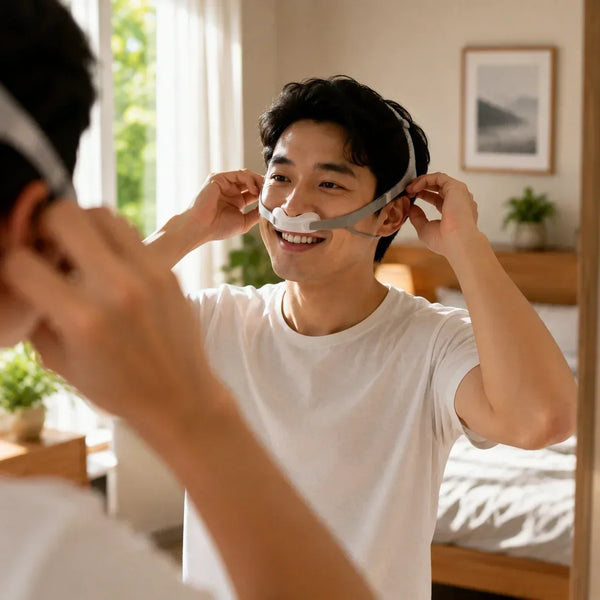
CPAP Mask Singapore: How to Find One That Actually Seals
You wake up with a red line across the bridge of your nose. Air hisses into your eye at 3am. You have...
Buy a CPAP Machine in Punggol, Sengkang & the North-East
Living in Punggol, Sengkang, Hougang or Serangoon? You can start CPAP therapy without hunting for a shop. YesCPAP sells CPAP and BiPAP...
Buy a CPAP Machine in Woodlands, Yishun & the North
Living in Woodlands, Yishun, Sembawang or Admiralty? You can buy a CPAP machine without travelling far. YesCPAP sells CPAP and BiPAP machines...