

Apple Watch
Your Apple Watch Detected Sleep Apnoea — Here's What to Do Next in Singapore

You woke up, glanced at your wrist, and there it was. A notification telling you your Apple Watch has spotted signs of sleep apnoea. Your stomach dropped a little, right? Mine would too. Suddenly your mind races — is this serious? Am I dying in my sleep? Do I need a machine on my face now?
Take a breath. You're in the right place. I'm Jo, a Registered Polysomnographic Technologist (RPSGT) based in Singapore, and I've used CPAP therapy myself since 2015. I read sleep data for a living. So let me walk you through exactly what that alert means — and what it doesn't.
Here's the honest version, before we go deep. Your watch is a smoke alarm, not a doctor. It noticed smoke. Now we figure out whether there's a fire.
What does the Apple Watch sleep apnoea notification actually mean?
The notification means your Apple Watch detected consistent "breathing disturbances" while you slept. It tracks your breathing patterns using the built-in accelerometer over a 30-day window. When those disturbances stay elevated across that period, it flags possible signs of moderate to severe sleep apnoea. It is a risk signal, not a diagnosis.
Apple is very clear on this point. The feature is "not intended to diagnose, treat or aid in the management of sleep apnoea". It works on Apple Watch Series 9 or later, Ultra 2, and SE 3, running watchOS 11 or newer.
So your watch is not lying to you. But it is also not the final word. It simply noticed a pattern worth checking. That alone puts you ahead of most people, because many never get a single warning.
Does the watch give me an AHI score? No — and that matters
This is where I see the most confusion, so let me clear it up. Your Apple Watch does not give you an AHI score. AHI stands for Apnoea-Hypopnoea Index. It counts how many times your breathing stops or shrinks per hour of sleep. It is the number sleep doctors actually use to confirm and grade sleep apnoea.
Here is the official severity scale that the medical world uses:
| Severity | AHI (events per hour) | What it means |
|---|---|---|
| Normal | Under 5 | No sleep apnoea by the usual definition |
| Mild | 5 to 15 | Still real apnoea — don't dismiss it as "only mild" |
| Moderate | 15 to 30 | Worth a serious treatment conversation |
| Severe | Over 30 | Treat with urgency — the heart and brain are under strain |
Your watch can hint that you might land in the moderate or severe range. It cannot tell you your exact number. Only a proper sleep study does that. Keep this distinction in your head — it shapes every step that follows.
How accurate is smartwatch sleep apnoea detection?
Smartwatch sleep apnoea detection is accurate enough to raise a flag, but not accurate enough to confirm anything. These features are designed to screen for possible signs, not to diagnose. Therefore, treat any alert as a prompt to get proper testing, not as a verdict.
Let me translate those numbers, because they actually matter for you. High specificity means false alarms are rare. So if your watch flagged you, take it seriously.
But here's the flip side I want you to remember. Sensitivity sits at only two-thirds. That means the watch misses about one in three cases, especially milder ones. Therefore, no alert does not mean no apnoea. If you snore loudly or feel exhausted despite sleeping, please don't wait for a notification that may never come.
The American Academy of Sleep Medicine puts it plainly. Consumer sleep tech is no substitute for medical evaluation. I agree completely. In my own practice, I treat these wrist alerts as a useful nudge, not a verdict.
Apple Watch vs Samsung vs Oura vs Wellue: which one flagged you?
Different devices work in different ways, and that changes how much weight you give the alert. Some watch you quietly every night. Others run a one-off test. A few simply track your oxygen and let you read between the lines. Here's how the popular ones compare, based on official sources and my own hands-on use.
| Device | How it detects | Singapore status | Gives a clinical AHI? |
|---|---|---|---|
| Apple Watch (Series 9+, Ultra 2, SE 3) | Accelerometer tracks breathing disturbances over 30 nights | Available since 2024 | No |
| Samsung Galaxy Watch (Watch7, Ultra, Watch4 and later) | Blood oxygen sensor over a two-night test within 10 days | HSA-approved, available since 2025 | No — flags risk only |
| Oura Ring | Tracks sleep stages and oxygen trends | Sold as a wellness device | No — cannot diagnose |
| Wellue O2 Ring | Records overnight blood oxygen dips (pulse oximetry) | Consumer recording device | No — shows oxygen drops only |
A quick note on each. The Samsung Galaxy Watch sleep apnoea feature is approved by Singapore's HSA. It runs an active two-night check, then switches itself off. Apple, by contrast, watches passively every night you wear it.
Oura is honest about its limits. The company states the ring cannot be used to diagnose sleep apnoea. And the Wellue O2 ring? I've used it myself to spot possible apnoea. It shows your oxygen dipping through the night, which can hint at trouble. Still, it's a clue, not a conclusion.
Why this alert matters more in Singapore than you think
Sleep apnoea is far more common here than most Singaporeans realise. More striking still, the vast majority had never been diagnosed. So if your watch flagged you, you're not an outlier — you're one of many who simply never knew.
If you want to understand the condition itself, start with my guide on the symptoms and treatment of sleep apnoea. It is a practical starting point.
Why does this gap exist? Often it's because sufferers sleep alone, with no partner to notice the gasping or the pauses. Meanwhile, the tiredness creeps in slowly, so they blame age or stress. That's exactly why a wrist alert can be quietly life-changing. It speaks up when nobody else does.
Your next step: confirm it with a real sleep study
The right move after a smartwatch alert is simple — get a proper sleep study to find your true AHI. A sleep study, or polysomnography, measures your breathing, oxygen, heart rate, and sleep stages overnight. It gives you the real number your watch could only guess at. From there, you and your doctor decide what's next.
In Singapore, you have two broad paths. You can go through a polyclinic referral to a public hospital, which is more subsidised but often involves a longer wait. Alternatively, you can take a private home sleep test, which is faster and done in your own bed. Costs differ a lot by route and provider, so I won't quote a figure that could be outdated. Instead, message us and we'll point you to a sensible next step.
If you want the official reference, the Ministry of Health fee benchmark for sleep apnoea (DRG E63Z) sets out subsidised hospital costs. Not sure where to start? Get a free consultation with us, or message us on WhatsApp, and we'll help you weigh up your options.
How to read your own sleep chart while you wait
Here's something I love teaching, because it puts a little power back in your hands. While you arrange a sleep study, you can learn to eyeball your own sleep chart — the hypnogram. A healthy night and a troubled night look genuinely different, and once you see it, you can't unsee it.
A normal hypnogram has a rhythm. The first third of the night holds plenty of deep sleep, called N3. The final third fills up with REM sleep, where you dream. In between sits lighter N2 sleep. Crucially, there shouldn't be constant jumps back to "wake".
An apnoea night looks messy instead. The chart gets peppered with sudden disruptions — bouncing between deep sleep and wake, then between REM and wake, over and over. On top of that, you'll often see frequent dips in blood oxygen. A calm night shows few or none. A troubled night shows them again and again.
So if your device shows a sleep graph, pull it up. Does it flow, or does it look chopped to pieces? You don't need to be an expert to sense the difference. Trust your eyes — then let a sleep study confirm what they tell you.
Where I come in, and where I don't
Let me be straight with you about my role. I don't diagnose you — that's for your doctor and your sleep study. What I do is everything that comes after. Once you have your AHI and a prescription, I help you choose the right CPAP machine, fit a mask that actually seals, and optimise your pressure so therapy feels comfortable, not like a chore.
This is the part most people get stuck on. The watch flags it. The clinic confirms it. Then someone hands them a box and waves goodbye. That's where therapy quietly fails. If you'd rather have someone walk the journey with you, reach out for a free consultation — or simply message us on WhatsApp. I'm happy to talk it through.
When you're ready, you can also browse our CPAP machines and masks to see what suits you — just click through and ask, no figures to wade through first. Meanwhile, two reads pair well with this one: how to adjust your CPAP pressure settings, and fixing CPAP dry mouth and mouth leak.
Frequently asked questions
Does the Apple Watch diagnose sleep apnoea?
No. The Apple Watch does not diagnose sleep apnoea. It detects breathing disturbances and flags possible signs of moderate to severe apnoea as a screening signal. Apple states clearly that the feature is not intended to diagnose or treat the condition. Only a proper sleep study, read by a doctor, can confirm a diagnosis.
How accurate is the Apple Watch sleep apnoea feature?
That means false alarms are rare, so an alert deserves attention. However, it misses roughly one in three cases. A normal result does not rule out sleep apnoea, especially milder forms.
Does the Apple Watch give me an AHI number?
No. The Apple Watch does not show you an AHI score. It only categorises your breathing disturbances as elevated or not elevated over a 30-day period. AHI, the number doctors use to grade severity, comes only from a clinical sleep study or a validated home sleep test.
What should I do if my Apple Watch detects sleep apnoea in Singapore?
Treat it as a prompt to get checked, not a reason to panic. See a GP, polyclinic, ENT, or respiratory doctor, then arrange a sleep study to find your true AHI. Once confirmed, you can discuss treatment options such as CPAP therapy with a qualified provider.
Is the Samsung Galaxy Watch sleep apnoea feature available in Singapore?
Yes. Samsung's sleep apnoea feature is approved by Singapore's Health Sciences Authority and available locally. It runs a two-night check on Galaxy Watch7, Watch Ultra, and Watch4 or later. Like the Apple Watch, it flags possible risk for undiagnosed adults but does not provide a clinical diagnosis.
How much does a sleep study cost in Singapore?
Costs vary by route, so it's best not to fixate on a single figure. The subsidised public hospital path differs from a private home sleep test, and prices change over time. Therefore, message us for a free consultation, and we'll guide you to the right option for your situation.
Where this goes next
Nothing on this page is a diagnosis, and it is not meant to stand in for one. If you have not had a sleep study, that is the step that comes before any equipment decision. A machine bought without a confirmed diagnosis and a prescribed pressure is simply a machine set to the wrong number.
If a sleep study has already confirmed obstructive sleep apnoea, the next question is equipment, and that is where we can help. Jo Ng, RPSGT, is a registered polysomnographic technologist: mask fitting, pressure setup, and the first two weeks of therapy. Message Jo on WhatsApp, use the contact page, or see what we stock in the full range.
Keep reading
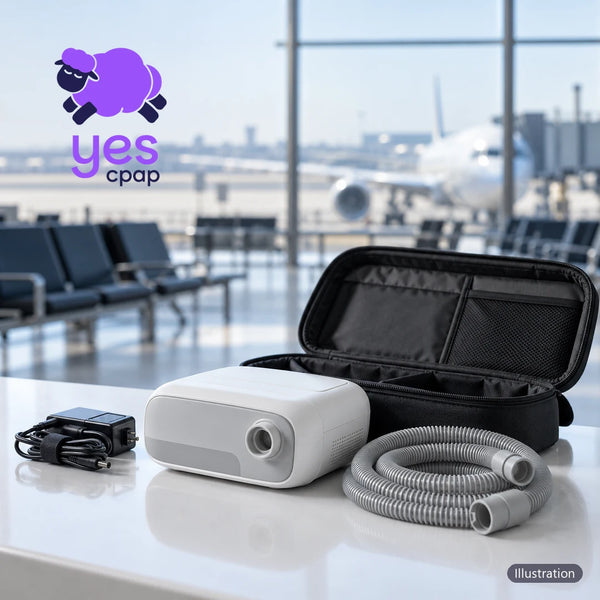
Travel CPAP Machine Singapore: 4 Things to Settle Before You Fly
A sleep technologist's pre-flight checklist for CPAP users, covering power, tubes, water, airline rules and lithium batteries, with sourced facts only.
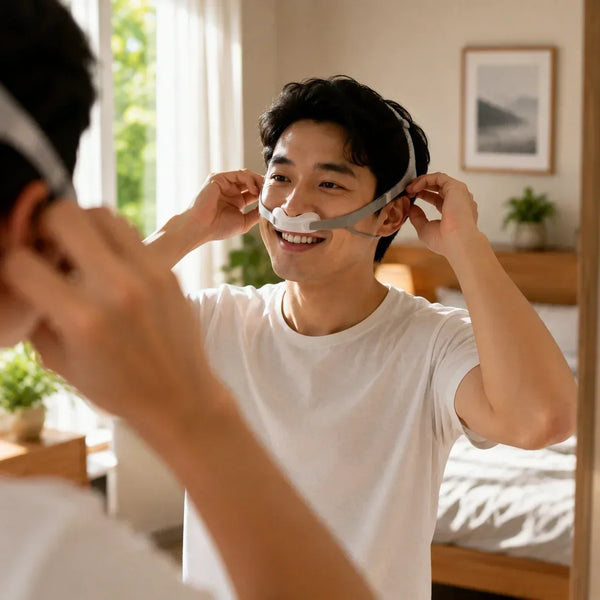
CPAP Mask Singapore: How to Find One That Actually Seals
You wake up with a red line across the bridge of your nose. Air hisses into your eye at 3am. You have...

CPAP Cost in Singapore: What You Actually Pay For
You have been quoted a number and it is more than you expected. Now you are wondering what else is coming, and...