

CPAP machine price Singapore
CPAP Rental Singapore: Rent or Buy? A 2-Minute Break-Even Guide

Updated 22 September 2026
S$1,400, the price of our iBreeze Auto, divided by the monthly rent on your quote: that one sum settles most CPAP rental Singapore questions, including whether to rent or buy. The answer is your break-even month, after which renting has cost you more than owning would have.
Short answer: if your doctor has confirmed you need CPAP every night, buying usually works out cheaper once you pass the break-even month, which is the machine price divided by the monthly rent. Renting earns its keep only as a short trial, to find out whether you can sleep with a mask, and only with an exit date you set before you sign.
| Monthly rent on your quote (illustrative) | iBreeze Auto (S$1,400) | iBreeze Pro (S$1,500) | iBreeze Plus Travel (S$1,700) | iBreeze Auto BiPAP (S$2,000) |
|---|---|---|---|---|
| S$50 a month | 28 months | 30 months | 34 months | 40 months |
| S$100 a month | 14 months | 15 months | 17 months | 20 months |
| S$150 a month | about 9 months | 10 months | about 11 months | about 13 months |
| S$200 a month | 7 months | 7.5 months | 8.5 months | 10 months |
Break-even month = machine price ÷ monthly rent. The fees in the left column are round numbers for illustrative arithmetic, not any supplier's price, so plug in the figure on your written quote. The machine prices are the live prices on each yescpap.com product page.
Key takeaways
- Break-even month = machine price ÷ monthly rent. At an illustrative S$100 a month, the S$1,400 iBreeze Auto breaks even at 14 months.
- Diagnosed and sure you'll use it nightly? Buying usually wins.
- Unsure you can sleep with a mask? A short rental trial can be worth it, with an exit date set first.
- Masks wear out on both routes, at around 6 months on average.
- Whoever supplies the machine, check the HSA dealer's licence and device registration.
Read the table from your own quote, not from ours. If your fee sits between two rows, so does your break-even month. That's the whole method. The rest of this page covers what the division leaves out.
Should you rent or buy a CPAP machine in Singapore?
There are three situations, and only one involves a rental.
If you have no diagnosis yet, neither renting nor buying is your next step. Assessment comes first, because your doctor decides whether you need a machine and which type. As MedlinePlus puts it, the provider, not the buyer, "will prescribe the type of PAP machine that targets your problem."
If you're diagnosed, your prescription is settled and you know you'll use it every night, buy. Every month of rent past the break-even month is money spent on a machine you could already own.
If you're diagnosed but unsure you can sleep with a mask on, a short rental can be worth it. Our rule of thumb (our view, not a published standard): decide before your rent paid reaches a third of the machine's price. On the S$1,400 iBreeze Auto, that line sits at about S$467.
Buying second-hand has its own risks, set out in our piece on whether a used CPAP machine is worth the risk.
Why is CPAP a running cost and not a one-off?
Because the therapy doesn't stop after the first month. The US National Heart, Lung, and Blood Institute (NHLBI) says: "It is important to use your PAP machine for all sleep, including naps." Its treatment page calls PAP "the most common treatment for sleep apnea."
NHLBI's guide to living with sleep apnoea adds that people who've been diagnosed "will need to schedule regular checkups to make sure that your treatment is working." For most people, then, CPAP is part of every night. That is exactly when rent keeps running and a purchase stops costing you.
If your doctor expects you to be on therapy for years rather than weeks, the break-even month in the table above is the only number that matters. Rent is priced per month. A purchase is priced once.
What still costs money after you buy?
Owning doesn't make CPAP free to run. The same NHLBI guide tells users to replace "the tubes, masks, and air filters" regularly. Our own DreamWear product page puts the average life of a new mask at around 6 months, "before giving way to poor seal and 'melty' / gooey frames". The ResMed P30i, in our experience, can last around 8 months.
So the honest comparison is never rent against nothing. It's rent plus masks against a one-time machine price plus masks.
Masks wear out on either route, because they sit on your face every night whoever owns the machine. If a rental includes a new mask you keep, that cost moves to the other side of the sum. Here's how to handle it.
How do you work out your own break-even month?
You need three numbers and two minutes. Do it before you sign.
- Get the monthly rent in writing, with the minimum term. A phone quote isn't one you can divide.
- Check whether a new mask is included. Our product pages say it plainly: "You need a CPAP Mask to go with your CPAP Machine". If the rental includes a new mask you keep, add the mask you'd otherwise buy (S$200 for a Philips DreamWear) to the purchase side.
- Divide the purchase side by the monthly rent. On the S$1,400 iBreeze Auto at an illustrative S$100 a month, that's 14 months. Add the S$200 mask and it becomes S$1,600 ÷ S$100, or 16 months.
- Compare that with how long you expect to rent. If your doctor set a trial length, use it; if not, write an exit date down now.
- Put the break-even date in your calendar. Still renting on that date? Then you're paying for the machine a second time.
If the fee changes after a minimum term, run the sum twice. The later fee decides a long rental.
What does owning actually cost over one to three years?
Here's the comparison over time, with the iBreeze Auto and a DreamWear Silicone Pillows mask replaced about every 6 months, the average our product pages give. The rental column uses the same illustrative S$100 a month and the same masks.
| By the end of | Buy: iBreeze Auto + a S$200 mask every 6 months | Rent at an illustrative S$100 a month + the same masks |
|---|---|---|
| Month 12 | S$1,800 | S$1,600 |
| Month 24 | S$2,200 | S$3,200 |
| Month 36 | S$2,600 | S$4,800 |
Renting is cheaper at month 12 in this example, which is why a short trial can make sense. By month 24 the order has flipped.
By month 36 the rental column is nearly double the purchase column. Lower rent pushes the flip later, and higher rent pulls it sooner.
Two things this table doesn't price. Filters and tubing wear too, so ask for those prices on either route. It also assumes the rental does the same job as the iBreeze Auto, an automatic 4 to 20 cm H₂O machine that NHLBI would class as one that "automatically adjusts the air pressure you receive during sleep". If the rental is a different kind of machine, your trial tests a different night from the one you'd own.
CPAP rental Singapore: when does renting make sense?
When the question is "can I sleep with this?" and only a few weeks of nights will answer it. MedlinePlus says: "It can take time to get used to using the PAP setup. The first few nights are often the hardest and you may not sleep well."
That's a fair reason to trial before you buy. One Singapore forum user, two weeks from the end of a one-month trial, described it well: "i dont get a full night's of rest as i wake up on and off to adjust the mask and mouth feels dry even with water in the humidifier."
Look at what that person was fighting. It wasn't the machine. It was the mask and a dry mouth, the part of CPAP that decides whether you keep going. MedlinePlus says a mask shouldn't leak air and "should not be too tight or too loose."
How do you make a CPAP machine rental test the right thing?
- Ask for a proper mask fitting at the start, not a box over the counter. Our guide to finding a CPAP mask that actually seals explains what a good fit feels like.
- Keep notes each night: hours used, leaks, dry mouth, how you felt by lunch. That record is what you and your doctor will decide from when the trial ends.
- Expect the first nights to be the worst. Our piece on what your first night on CPAP is like covers them.
- Raise problems early. NHLBI's advice: "Be patient, as it may take time to adjust to breathing with the help of a PAP machine."
If the only problem was the mask, you've learned about masks, not about renting. That's worth knowing before you buy anything.
When does renting become the expensive choice?
Renting turns expensive quietly, one invoice at a time. Watch for these four patterns.
- You're past the break-even month and still renting because switching feels like effort.
- The trial had no end date. A rental with no exit date isn't a trial. It's a slow purchase at a higher price.
- You rented one kind of machine but plan to buy another, so the trial answered a question about the wrong one.
- You already know you'll use it every night. If your prescription is settled and you've slept with a mask before, a trial has nothing left to tell you.
None of this means rent already paid was wasted. Rent on a trial that answered a real question was money well spent. The waste is only the rent paid after the question was answered.
What should you ask a rental supplier in writing?
Ask these before you sign, and keep the replies. A good supplier will answer every one without hesitating.
- What is the monthly fee, is there a minimum term, and does the fee change after it?
- What does the fee cover: humidifier, heated tubing, filters, delivery and collection?
- Is a mask included, is it new, and can a different size be swapped in?
- What happens to the rent I've paid if I decide to buy?
- Who does the setup and the mask fitting, and is there a charge for an in-person visit?
- Can I see my own usage history, such as hours used and mask leak?
- Who owns and services the machine, and what happens if it stops working mid-trial?
- Is the machine registered with HSA, and do you hold a dealer's licence?
If a supplier won't put these answers in writing, treat that as your answer.
How do you check HSA registration yourself?
That last question isn't a formality. Singapore's Health Sciences Authority states: "We require companies to obtain a dealer's licence before manufacturing, importing or supplying medical devices." Its regulatory overview adds that medical devices need registration before supply, apart from low-risk Class A devices.
You don't have to take anyone's word for it. HSA's Infosearch page lists the Dealer's Licence Database alongside the Singapore Medical Device Register (SMDR). The same check applies to anyone selling you a machine, including us.
Our own machines show their numbers on the product pages: the iBreeze Auto and iBreeze Pro are listed as "HSA approved (DE0507383)". Ask any rental supplier for the equivalent number, then search it. It takes a minute, and it tells you more about a supplier than any brochure will. If the details don't match what you were told, ask why before you sign.
What you get when you buy from YesCPAP
One thing first: YesCPAP sells machines, and we don't rent them. If you need a rental trial, it will be with another supplier, and the questions above are how to judge it. If you've decided to buy a CPAP machine in Singapore from us, here's what each costs on its live product page.
| Machine | Price on yescpap.com | What the product page says it is |
|---|---|---|
| iBreeze Auto | S$1,400 | Auto CPAP, 4 to 20 cm H₂O, heated humidifier, heated tubing, SD card |
| iBreeze Pro | S$1,500 | The iBreeze Auto plus a gentler algorithm designed for women |
| iBreeze Plus Travel | S$1,700 | Compact travel auto CPAP with a humidifier dock for home use |
| iBreeze Auto BiPAP | S$2,000 | Dual pressure: one level for breathing in, another for breathing out |
Masks are sold separately: the Philips DreamWear masks are S$200 and the ResMed P30i is S$250. I use the DreamWear Silicone Pillows myself, and we use the iBreeze ourselves, every single night.
What comes with a new machine from us?
With a new machine, the product page lists four free, optional services: a therapy commencement consultation, early days coaching, a pressure optimisation consultation and mask fit coaching. They are "delivered to you remotely via whatsapp, or in-person fees will apply." In the box, the iBreeze Auto and Pro each come with one heated and one non-heated tube, a carrier bag and a universal power brick with a Singapore three-pin plug.
Choosing between our two main machines? See how the iBreeze Auto and iBreeze Pro differ. If the difference still isn't clear after reading it, ask us on WhatsApp before you choose.
For the months after you buy, and the habits that keep a machine in use, read how people actually stick with CPAP.
Before you decide: the clinical line
One line before you message us. YesCPAP is run by a sleep technologist, not a doctor, and your diagnosis and prescription come from your physician.
We handle the equipment, the setup and the mask fit, and we won't tell you to start, stop or change therapy. That conversation belongs with your doctor, whichever route you choose, rent or buy.
If you have your prescription or sleep study report in hand, send it to Jo on WhatsApp at +65 9858 4461 and ask whatever the table didn't answer. Or start with the iBreeze Auto product page, where the price and everything in the box are listed. Either way, you'll get a straight answer on whether buying beats your CPAP rental Singapore quote.
Frequently asked questions
Is it cheaper to rent or buy a CPAP machine in Singapore?
It depends on how long you need it. Divide the machine price by the monthly rent you're quoted: on the S$1,400 iBreeze Auto, an illustrative S$100 a month breaks even at 14 months. Before that, renting costs less; after it, buying does, so for nightly long-term therapy buying usually wins.
Does YesCPAP rent CPAP machines?
No. We sell machines and masks, and we don't run a rental service. If you and your doctor want a trial first, rent from a supplier with an HSA dealer's licence, set an exit date, and use the questions on this page. When you're ready to buy, our prices are on each product page.
Can I buy a CPAP machine without a sleep study?
We wouldn't recommend it, whoever is selling. Whether you need CPAP at all, and which type, is your doctor's decision after an assessment. MedlinePlus says the provider, not the buyer, "will prescribe the type of PAP machine that targets your problem." Get assessed first, then choose equipment.
How long should a CPAP trial last?
If your doctor has set a trial length, that's the length. If not, pick an end date before you sign, well short of your break-even month, and put it in writing with the supplier. MedlinePlus says the first few nights are often the hardest, so judge the trial on the later nights, with a properly fitted mask.
Do I need to buy a mask separately?
Yes. A CPAP machine needs a mask, and ours are sold separately: S$200 for the Philips DreamWear masks and S$250 for the ResMed P30i. Our product pages note that CPAP masks are universal, except those built for the ResMed AirMini. Expect to replace a mask roughly every 6 months.
Can I rent first and buy from YesCPAP later?
Yes. You can trial with a rental, then buy once you and your doctor are sure. When you switch, bring your prescription, your notes or usage record from the trial, and the name of the mask that worked. That saves you repeating the part of the trial that already gave an answer.
How can I check a rental machine is legitimate?
Ask for the device's HSA registration and the supplier's dealer's licence, then look both up on HSA Infosearch, where the Dealer's Licence Database sits next to the device register. Do that before you sign any CPAP rental Singapore agreement.
This article is for general awareness only and is not medical advice, diagnosis or treatment. Sleep apnoea is diagnosed by a physician, and CPAP therapy requires a doctor's prescription. Always consult a qualified healthcare professional about your own situation before starting, changing or stopping any therapy.
Keep reading
CPAP Machine for Elderly Parents: A 4-Check Buying Guide
Four checks before you buy a CPAP for a diagnosed parent in Singapore: the doctor's plan, easy controls, a magnet-free mask and...
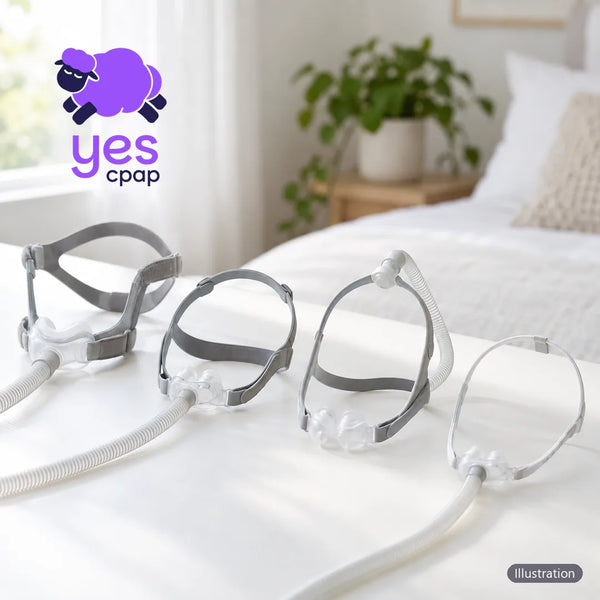
Best Under the Nose CPAP Mask in Singapore: 4 Compared
Nose length and who shares your bed decide it. How the 4 under-the-nose masks at YesCPAP compare on fit, noise, magnets and...
How Long Does a CPAP Machine Last? 4 Signs It Is Time
Your CPAP's manual, not an online average, says when to replace it: 10 years for Resvent's iBreeze CPAP models, 5 for the...