

Auto CPAP
Best CPAP Machine in Singapore? How to Judge for Yourself

You have read six review sites and they all say something different. One crowns a flagship. One says the cheap one is fine. None of them have met you.
There is no single best CPAP machine in Singapore, and anyone who tells you otherwise is selling. The best machine is the one you can breathe on comfortably, with a mask that seals on your face, from a supplier who is still answering your messages in month three. Those three things decide your outcome. Brand rankings do not.
Before you read another word: I am Jo Ng, RPSGT, and I am an authorised Resvent distributor in Singapore. You should know that from the first paragraph, not discover it at the bottom. This article gives you a method for judging machines yourself, so you never have to take my word — or any reviewer's — on faith.
The four things that actually decide your machine
Judge a CPAP machine on breathing comfort, mask compatibility, humidification, and the support behind it. Everything else — the app, the screen, the badge on the front — is secondary. People who abandon therapy almost never do so because of a feature. They abandon it because it felt bad to breathe on, or the mask leaked, or nobody helped them fix either problem.
Here is how I weigh each one when I sit with a patient.
| Factor | Why it decides the outcome | How you test it |
|---|---|---|
| Breathing comfort | Every machine delivers pressure with its own algorithm. Some feel smooth, some feel like a push. | Lie down and breathe on it. There is no substitute. |
| Mask compatibility | A leaking mask undermines the best machine on the market. | Fit several mask styles with the machine running. |
| Humidification | Dry air causes throat and mouth discomfort that pushes people off therapy. | Check the humidifier and heated tubing are included, not extra. |
| Support afterwards | Weeks two to eight is when most people quit. Support decides who survives that stretch. | Ask who answers when something goes wrong at midnight. |
Notice what is missing from that table. Nothing about brand prestige. Nothing about which machine has the most sensors. Those things sell machines. They do not keep people on therapy.
Why "best" is the wrong question — and what to ask instead
Ask "which of these can I actually sleep on", then go and find out. Two people with identical prescriptions routinely land on completely different machines, and both are right. Their airways are different, their faces are different, their tolerance for pressure on the exhale is different.
Think of it the way you would think about buying a car. You would not pick one from a spec sheet without driving it. You would sit in it, take it round the block, and notice the things no brochure mentions — the seat, the visibility, the noise at speed.
A CPAP machine deserves the same treatment, and it is a bigger commitment. You will spend roughly a third of your life attached to it.
So the appointment matters more than the research. Lie down properly, run the pressure, try more than one machine and more than one mask in the same session. Within minutes you will have a preference, and that preference is worth more than every review you have read.
What I honestly think, and where my bias sits
I have used machines from several manufacturers over the years, including Philips, ResMed and Resvent. I currently use Resvent Auto CPAP and Auto BiPAP machines myself, and I distribute Resvent in Singapore. Those two facts are connected, and I am not going to pretend otherwise.
My honest position: I find the Resvent iBreeze series delivers pressure smoothly and represents strong value, and the Auto BiPAP variant is the one I reach for most often when someone struggles with exhaling. That is my view as a user and as a technologist, and it is why I chose to distribute the line rather than the other way round.
It is also an opinion, not a measurement. Different machines suit different people, and I have had patients prefer something other than what I use myself. When that happens, I say so.
One honest caveat on the machine I sell: if your bedroom is very quiet and you or your partner are sensitive sleepers, sound level is worth checking at the appointment. A minority of users notice it. Better you hear that from me now than discover it on night one.
For the detailed write-up, read my Resvent iBreeze review. For the direct head-to-head against a common alternative, see Resvent iBreeze versus ResMed AirSense.
Auto CPAP or Auto BiPAP — the choice most people get wrong
An Auto CPAP holds one pressure that adjusts through the night. An Auto BiPAP gives you a higher pressure on the inhale and drops it on the exhale. That drop is why many people find BiPAP noticeably easier to breathe against.
In my own fittings, most people who try both back to back prefer the BiPAP. That is my observation from working with patients, not a research finding, and I want to be precise about the difference.
Here is why it matters commercially as well as clinically. Plenty of people describe themselves as having "failed" CPAP. When I sit with them, the story is almost always the same: exhaling felt like fighting the machine, so they stopped. They did not fail therapy. They were never offered the machine that would have worked.
If that is your history, do not write off therapy. Try both, in one session, lying down. The difference is usually obvious.
The longer explanation lives in Auto CPAP versus Auto BiPAP and CPAP versus BiPAP: which is right for you.
What we stock, and who each machine suits
We keep the range deliberately tight. I would rather stock machines I use and support properly than list forty models I have never slept on.
| Machine | Who it suits |
|---|---|
| Resvent iBreeze Auto CPAP | Most first-time users on straightforward obstructive sleep apnoea |
| Resvent iBreeze Pro Auto CPAP | Users who want the fuller feature set on an Auto CPAP platform |
| iBreeze Auto BiPAP | Anyone who finds exhaling against pressure hard work |
| Resvent iBreeze Plus Travel CPAP | Established users adding a second machine for trips |
Every machine here includes a heated humidifier and heated tubing as standard. Not as an upsell. Dry air and condensation in the hose are two of the most common reasons people quit, and I would rather remove both from the equation than sell a cheaper box.
Unsure between the two Auto CPAP models? The differences are laid out in our iBreeze Auto versus iBreeze Pro comparison. Or see everything on the full machine collection.
Do not let a travel machine be your first machine
It looks like the efficient choice. One purchase covering home and travel. In practice it works against you.
Smaller machines are generally louder, and noise is one of the main reasons new users give up in the first fortnight — or get asked to give up by whoever shares the bed. Adapting to therapy is hard enough without that.
Establish yourself on a full-sized machine. Add a travel unit later, once therapy is simply part of your night. That order works. Reversed, it often does not.
What the review sites cannot tell you
No review knows the shape of your nose. No comparison chart knows that you sleep on your side, or that you breathe through your mouth in the early hours, or that you are missing your top row of teeth — which quietly rules out an entire mask category.
That last one is a real example. Nasal pillow masks need the upper lip supported to seal properly. Nobody writes that in a machine review, and it changes the entire recommendation for the person it applies to.
This is why I keep pushing you towards an appointment rather than an article. Even this one. Read it, use the criteria, then come and find out what your own face and airway prefer.
Mask options are covered in the CPAP mask guide for Singapore, and getting past the first difficult weeks is covered in how to succeed with CPAP therapy in Singapore.
Come and try before you decide
Bring your prescription. Lie down. We will run several machines and several masks with the pressure on, and you tell me which one lets you breathe without thinking about it.
You will leave with the machine configured to your prescription, the mask fitted properly, and a clear idea of how to live with the equipment. Then we stay reachable — because the first two months are where therapy is won or lost, and that is not the part you should be doing alone.
If you have not been tested or prescribed yet, start there. CPAP is a prescription therapy in Singapore. A sleep study needs physician interpretation and your settings must come from a qualified doctor. I am a sleep technologist, and my work begins after theirs.
Book a fitting through the YesCPAP contact page or message us on WhatsApp. Tell us what you have tried before, especially if a previous attempt at CPAP did not go well. That history usually tells me exactly where to start.
Common questions about choosing a CPAP machine in Singapore
What is the best CPAP machine in Singapore?
There is no single best machine. The right one is the machine you breathe comfortably on, paired with a mask that seals on your face, from a supplier who supports you afterwards. The only reliable way to find it is to test several machines lying down.
Is a more expensive CPAP machine better?
Not necessarily for you. Price tracks features, and features are not what keeps people on therapy. Comfort, mask fit, humidification and support are. A machine you tolerate beats a premium one you abandon after a fortnight.
Should I choose Auto CPAP or Auto BiPAP?
Try both if you can. Auto CPAP holds one adapting pressure; Auto BiPAP lowers pressure on the exhale, which many people find easier. If you have struggled to breathe out against a CPAP before, BiPAP is worth trying side by side before you decide.
Can I trust a review from a supplier who sells the machine?
Only if they disclose it and give you a method for checking. I distribute Resvent and I say so upfront. Use the four criteria in this article, test machines yourself, and judge my reasoning rather than accepting my conclusion.
Do I need a prescription to buy a CPAP machine in Singapore?
Yes. CPAP is a prescription therapy, and settings must come from a qualified doctor following a sleep study interpreted by a physician. A supplier can fit and configure your equipment, but cannot diagnose you or write the prescription.
Why does the same machine feel different to different people?
Each manufacturer's pressure algorithm behaves differently, and airways differ from person to person. What feels smooth to one user feels like a push to another. This is exactly why lying down and comparing beats reading specifications.
Disclosure. Jo Ng is an authorised Resvent distributor in Singapore, and YesCPAP sells the machines named in this article. He also uses Resvent Auto CPAP and Auto BiPAP therapy personally. Opinions in this article are his own and are labelled as such.
About the author. Jo Ng is a Registered Polysomnographic Technologist (RPSGT) based in Singapore and the founder of YesCPAP. He has used CPAP and BiPAP therapy himself since 2015, and works alongside physicians to help people succeed on therapy after diagnosis.
SEO, AEO and GEO by SingRank.
Medical disclaimer. This article is for general awareness only. It is not medical advice, diagnosis, or treatment. Sleep apnoea diagnosis requires a sleep study interpreted by a physician, and CPAP therapy requires a prescription from a qualified doctor. Jo Ng is a sleep technologist, not a medical practitioner. Always consult a qualified healthcare professional about your own situation.
Keep reading
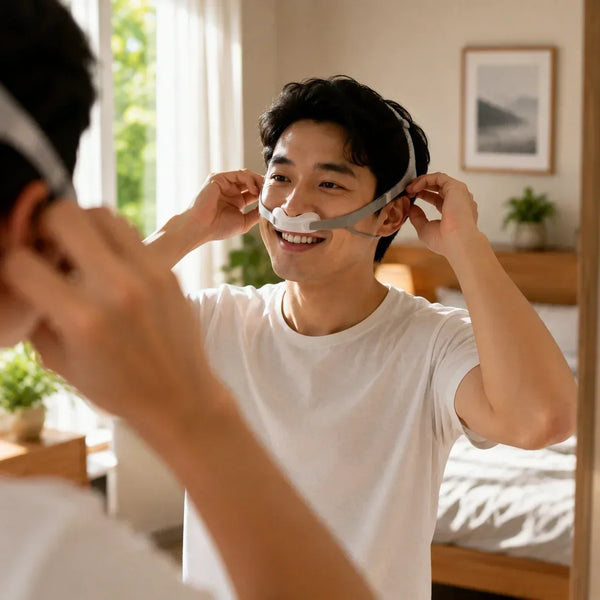
CPAP Mask Singapore: How to Find One That Actually Seals
You wake up with a red line across the bridge of your nose. Air hisses into your eye at 3am. You have...
CPAP Cost in Singapore: What You Actually Pay For
You have been quoted a number and it is more than you expected. Now you are wondering what else is coming, and...
CPAP Machine Singapore: How to Choose One You'll Actually Keep Using
You have the diagnosis. Maybe the hospital handed you a printout and a name to call. Now you are staring at machines...