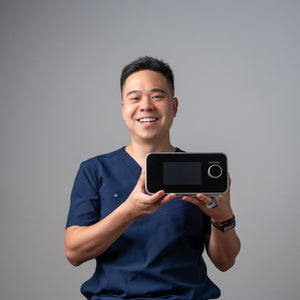
If you snore loudly, wake up tired, or someone has noticed you stop breathing at night, a sleep study answers the real question: do you actually have sleep apnoea? I'm Jo Ng, a Registered Polysomnographic Technologist (RPSGT) in Singapore, and I've set up sensors on many patients and used CPAP myself since 2015. In this guide, I explain how a sleep study works, home versus lab options, and how to get tested here.
Let me be clear from the start. A sleep study is a diagnostic test, not a treatment. Therefore, it tells you and your doctor what's happening, so any decision afterwards rests on data rather than guesswork. Sleep apnoea is also widely underdiagnosed, because many sufferers dismiss snoring and daytime tiredness as normal. A test is simply how you find out which group you're in.
What is a sleep study?
A sleep study, or polysomnography, is an overnight test that records your breathing, blood oxygen, heart rate, and sleep stages. It shows your doctor whether you have sleep apnoea and how severe it is. In short, it turns vague tiredness into measurable data. Consequently, it becomes the foundation for any safe, accurate treatment decision your provider makes.
The test measures events while you sleep, not just symptoms while you're awake. For example, it counts how often your breathing pauses and how far your oxygen drops. Additionally, it tracks whether those events fragment your deep sleep. As a result, two people who both feel "just tired" can receive very different diagnoses once the numbers are in.
Do you need a sleep study?
You likely need a sleep study if you have persistent loud snoring, witnessed breathing pauses, or unrefreshing sleep despite enough hours. Daytime sleepiness, morning headaches, and high blood pressure add weight too. However, only a doctor confirms the need, because these signs overlap with other conditions. Therefore, treat this as a prompt to get assessed, not a self-diagnosis.
Some signals deserve faster action. Specifically, falling asleep while driving or in meetings is a safety red flag. Similarly, a heart or stroke history alongside snoring raises the stakes. If any of these sound familiar, my guide to the hidden signs of sleep apnoea may help you decide whether to book a test.
Home sleep test vs in-lab sleep study
An in-lab study (Level 1) runs overnight in a sleep lab, attended by a technologist, with full sensors. A home sleep test (often Level 3) uses fewer sensors in your own bed, usually unattended. Lab studies capture more detail, while home tests offer comfort and convenience. Ultimately, your doctor decides which suits your situation and health background.
| Feature | In-lab study (Level 1) | Home sleep test (Level 3) |
|---|---|---|
| Where | Sleep lab, attended overnight | Your own bed, usually unattended |
| Sensors | Full set, including brain waves (EEG) | Reduced set: airflow, effort, oximetry |
| Detail captured | Highest, including sleep stages | Good for straightforward OSA screening |
| Comfort | New environment for some | Familiar, natural sleep setting |
| Best when | Comorbidities, e.g. heart or stroke history | Otherwise healthy, suspected uncomplicated OSA |
Importantly, home tests are often very accurate for uncomplicated obstructive sleep apnoea. However, if you have a history such as a heart attack or stroke, a lab study is usually safer and more thorough. In those cases, closer overnight monitoring matters, so your doctor will typically steer you towards the lab.
What happens during an in-lab sleep study
In the lab, a technologist attaches sensors before you sleep, then monitors you overnight. These sensors read brain waves (EEG), heart rate (ECG), muscle movement (EMG), and airflow. They sit on your scalp, under your nose, on your chest, and on your limbs. Nothing should hurt, and you sleep as normally as the setting allows.
The sensors feed a computer, and together the readings show how you slept. For example, brain-wave data reveals whether you reached deep sleep or kept getting pulled back to "wake". Here's a practical tip from my own set-ups: shower and wash your hair beforehand. Clean skin and scalp help the sensors stick, which makes for a smoother night.
What happens during a home sleep test
A home sleep test records your breathing and oxygen overnight using a smaller kit. Sometimes a technologist fits the sensors first, then collects the kit the next morning. Other times, you follow a simple DIY set-up guide yourself. Either way, you sleep in your own bed, which many people find far more natural and relaxing than a lab.
This convenience matters, because a calmer night often means more representative data. If a home screening suits you, it can be an accessible first step before seeing a specialist. To ask about our DIY home sleep test option, simply reach out via our contact page or browse the catalogue. A positive result still needs a doctor to confirm the diagnosis.
What is a split-night study?
A split-night study combines diagnosis and treatment trial in one lab session. The night begins as a normal diagnostic study. Then, if the technologist sees clear signs of sleep apnoea, they may apply a CPAP mask with pressure running to find suitable settings. Consequently, you achieve a two-in-one visit, which saves you a second trip to the lab.
Understanding your sleep study results
Your results centre on the AHI, the Apnoea-Hypopnoea Index. It counts how many times per hour your breathing pauses or shrinks. A higher AHI means more disrupted breathing and, usually, more fragmented sleep. The American Academy of Sleep Medicine groups severity into the bands below, which your doctor uses to guide treatment.
| AHI (events per hour) | Classification |
|---|---|
| Under 5 | Normal range |
| 5 to 15 | Mild sleep apnoea |
| 15 to 30 | Moderate sleep apnoea |
| Over 30 | Severe sleep apnoea |
However, the AHI isn't the whole story. Your report also shows oxygen desaturations, snoring, and sleep stages. Notably, "mild" still means real sleep apnoea, so don't dismiss a lower score. Your doctor reads the full picture, including your symptoms, before deciding what to do next.
How much does a sleep study cost in Singapore?
Sleep study costs in Singapore vary widely, so I won't quote a single figure that quickly goes stale. Broadly, a private in-lab study costs more than a subsidised study at a public institution. Meanwhile, a home sleep test usually sits lower still. Therefore, confirm the exact price directly with the provider or hospital before you book.
For many people, a home screening is the most accessible starting point. It gathers real data at a lower cost, which you can then bring to a doctor. If budget is a concern, ask us about a DIY home sleep test, or check current options on our catalogue. As always, costs and any applicable subsidies change, so verify them at the point of booking.
How to get a sleep study in Singapore
Getting tested follows a simple path, and you don't need to navigate it alone. First, speak to a doctor about your symptoms. Next, your doctor assesses you and recommends either a home test or a lab study. Finally, you complete the test and receive your results. From there, your provider explains whether treatment is needed.
- See a GP or sleep specialist about your snoring or tiredness.
- Let the doctor decide between a home test and an in-lab study.
- Alternatively, start with a home screening to gather data first.
- Get your diagnosis, then discuss treatment if your AHI warrants it.
If you'd like help finding the right professional, my overview of sleep specialists and clinics in Singapore is a useful starting point. Meanwhile, if a smartwatch first raised the alarm, see what to do after an Apple Watch sleep apnoea alert.
After your sleep study: what comes next
If your study confirms obstructive sleep apnoea, CPAP therapy is the usual first-line treatment. The American Academy of Sleep Medicine regards it as the gold standard. However, the test is only the beginning. Success depends on the right machine, the right mask, and proper follow-up. Therefore, treat your diagnosis as a starting line, not a finish line.
This is where I focus most of my work with patients. Once you're diagnosed, my guide on how to succeed with CPAP therapy walks you through the journey. If your doctor raises bilevel therapy, my comparison of CPAP vs BiPAP explains the difference. For a free, no-pressure chat about your results, contact us or message us on WhatsApp.
Frequently asked questions
Do I need a sleep study to get a CPAP machine in Singapore?
In most cases, yes. A sleep study confirms whether you have sleep apnoea and how severe it is, which guides safe treatment. Your doctor uses the results to decide if CPAP is appropriate and what pressure suits you. Therefore, testing first protects you from treating a problem you may not actually have.
What is the difference between a home sleep test and an in-lab study?
An in-lab study runs overnight in a sleep lab with full sensors, attended by a technologist. A home sleep test uses fewer sensors in your own bed, usually unattended. Lab studies capture more detail, including sleep stages. Meanwhile, home tests offer comfort and convenience, and they suit straightforward cases well.
How accurate is a home sleep test?
Home sleep tests are often very accurate for uncomplicated obstructive sleep apnoea. However, they capture less detail than a lab study, since they use fewer sensors. Therefore, if you have heart, lung, or neurological conditions, a doctor usually recommends an in-lab study instead. Your provider decides which test fits your health background.
How much does a sleep study cost in Singapore?
Costs vary widely, so I won't quote a single figure that goes stale. Generally, a private in-lab study costs more than a subsidised public one, while a home test usually sits lower. Subsidies and prices change over time. Therefore, always confirm the exact cost directly with the provider or hospital before booking.
What does AHI mean in my sleep study results?
AHI stands for the Apnoea-Hypopnoea Index. It counts how many times per hour your breathing pauses or shrinks during sleep. Under 5 is normal, 5 to 15 is mild, 15 to 30 is moderate, and over 30 is severe. However, your doctor reads the full report, not the AHI alone, before deciding on treatment.
Can a smartwatch replace a sleep study?
No. A smartwatch or ring can flag possible sleep apnoea, which is genuinely useful as an early prompt. However, it cannot diagnose the condition or measure its severity reliably. Therefore, treat a wearable alert as a reason to get a proper sleep study, not as a diagnosis you can act on alone.
How do I get a sleep study in Singapore?
Start by speaking to a GP or sleep specialist about your symptoms. Your doctor then recommends a home test or an in-lab study, based on your health. Alternatively, you can begin with a home screening to gather data first. Either way, a doctor confirms the diagnosis and guides any treatment afterwards.