

Buying Guide
CPAP Machines in Singapore: Prices and Setup

Quick answer: A CPAP machine in Singapore from YesCPAP costs S$1,400 to S$2,000 on our product pages, and a mask is extra, from S$200. CPAP therapy needs a doctor's prescription, and your doctor sets the pressure. We look after the equipment, the mask fit and the setup.
Correction, 21 October 2026: an earlier version of this page listed machine prices of S$1,200 to S$1,800 and described a free support package valued at S$800 or more, with 24/7 support and home visits. Those figures were wrong or could not be supported. The prices below are from our product pages today. Setup help is limited to the free, optional WhatsApp services listed on the iBreeze page, and in-person visits carry a fee.
The problem: a CPAP machine you paid for but cannot sleep with
A machine that costs S$1,400 on its product page is a lot to leave in a cupboard. A machine in a cupboard is a common worry, and it is usually fixable.
Three problems come up again and again in mask-fit and setup chats. The mask leaks. The air feels too dry, or water collects in the tube, in a cool air-conditioned room. Or nobody showed them what the numbers on the screen mean, so they cannot tell whether the night went well.
If you have been diagnosed, you are in a large group. A community study of Singapore adults aged 21 to 79 estimated that 30.5% have moderate-to-severe sleep-disordered breathing, and 91% of those had never been diagnosed (Tan et al., Respirology, 2016). Getting the diagnosis is the first hurdle. Keeping up the therapy is the second.
This page is for the second hurdle. It covers what each machine costs, which one fits your situation, how to set it up for a humid, air-conditioned Singapore bedroom, and what to do in the first two weeks.
CPAP machine Singapore prices: what each one costs
These are the prices on our product pages today. A mask is separate, because the right one depends on your face.
| Machine | Price | What sets it apart | Who it suits |
|---|---|---|---|
| Resvent iBreeze Auto CPAP | S$1,400 | Automatic pressure 4 to 20 cm H2O. Heated humidifier and heated tubing included. Ramp of up to 60 minutes. | Your prescription says auto CPAP and this is your first machine. |
| iBreeze Pro Auto CPAP | S$1,500 | Same pressure range as the Auto, plus two extra modes: Auto CPAP Women and CPAP-V. | Your doctor wants one of those two modes. |
| iBreeze Plus Travel CPAP | S$1,700 | Compact. 100 to 240V power supply. Camping battery pack of up to 1.5 nights per charge (ask us whether it is in the box before you pay). | You fly or sleep away from home often. |
| iBreeze Auto BiPAP | S$2,000 | Separate inhale and exhale pressures, 4 to 25 cm H2O. | Your doctor has prescribed BiPAP. |
Masks are S$200 for the Philips DreamWear silicone pillows, the DreamWear under the nose and the DreamWisp, and S$250 for the ResMed P30i. Together, an iBreeze Auto and a S$200 mask come to S$1,600.
Our CPAP machine price guide walks through five ways to buy, so you can set our prices against the other routes.
What comes in the box with the iBreeze Auto
When you compare quotes, compare what is in the box. For the iBreeze Auto, our product page lists:
- The machine, 24 cm long, 13 cm wide and 12 cm high.
- A heated humidifier, with an automatic setting and manual levels from 1 to 8.
- One heated tube and one non-heated tube.
- An SD card.
- A carrier bag and an instruction manual.
- A universal power brick with a Singapore and UK three-pin plug, input 100 to 240V.
The page also lists Auto Start, Auto Stop and a Mask Fit feature. E-Comp raises the pressure gradually over the first few days for new users. R-Care gives optimised pressure from earlier in the night. You still need a mask. Masks are universal for this machine, with one exception: masks built for the ResMed AirMini.
Which CPAP machine fits your situation
Start with your prescription, then match it to your life. One branch per question.
- If you have an auto CPAP prescription and this is your first machine: the iBreeze Auto. The heated humidifier and heated tubing come in the box, which helps in a cool, air-conditioned room.
- If your doctor asks for Auto CPAP Women or CPAP-V: the iBreeze Pro. Its product page describes CPAP-V as a 7, 14 or 28 night titration before the machine switches to straight CPAP, and Auto CPAP Women as a gentler pressure algorithm. We could not find a Resvent document that explains how that algorithm differs, so ask your doctor whether you need it. The Pro is not a "women's machine": the usual Auto CPAP and CPAP modes are still there.
- If you travel often: the iBreeze Plus Travel. It runs on 100 to 240V. Airline rules on carrying a CPAP machine differ, so check with your airline before you fly.
- If your doctor has prescribed BiPAP: the iBreeze Auto BiPAP. We do not choose BiPAP by age or by feel. That is a clinical decision. Auto CPAP vs Auto BiPAP explains the difference so you can ask your doctor the right question.
What makes the Resvent iBreeze our first pick for CPAP in Singapore?
There is no single winner among CPAP machines. The right one is the one you can breathe on comfortably, night after night. We recommend the iBreeze Auto for most first-time auto CPAP users for two plain reasons. It costs the least of the four. And the heated humidifier and heated tubing are already included, so you do not add them later.
Our product pages say we use it ourselves every night. That is where our recommendation comes from, and it is an opinion, not a ranking.
Setting up for Singapore's humid, air-conditioned bedrooms
Why do CPAP machines struggle in Singapore's tropical climate?
They do not fail. The problem is water. Humidified air leaves the machine and travels down the hose. In a cool, air-conditioned room some of that moisture turns back into droplets, and you wake up to a gurgling tube. This is called rainout.
Three things change it: how warm the tube is, how much humidity you ask for, and where the machine and hose sit. Resvent's iBreeze manual says to place the machine below your sleeping position and away from air-conditioning vents. Its humidifier setting runs from Auto and Off to levels 1 to 8, with a default of 3.
Change one thing at a time, and leave it for two or three nights before you judge it. Our guide to heated tubing and rainout shows how to keep a simple log, so you know which change worked.
Check you are using the heated tube
The iBreeze comes with one heated tube and one non-heated tube. It is easy to connect the wrong one without noticing. If the plain tube is on the machine, your heated tube is sitting in the box doing nothing. Check which one is attached before you change any setting.
What to do in your first two weeks
- Bring your sleep study report or prescription. Your pressure range comes from your doctor, not from us and not from the machine.
- Choose the mask first. We generally recommend the DreamWear silicone pillows for most users, followed by the DreamWisp. The right mask is the one that seals without you pulling the straps tight. Our mask fit guide shows what a good seal feels like.
- Set up with a sleep technologist. With a new machine, a therapy commencement consultation, early-days coaching, a pressure optimisation consultation and mask fit coaching are free and optional. We deliver them remotely over WhatsApp. In-person sessions carry a fee. We read your data with you. Any change to your prescribed pressure still comes from your doctor.
- Check your leak figure every morning. If leak is high, fix the mask before you judge anything else. A leaking mask makes every other number unreliable. How to read your CPAP data explains the four numbers worth watching.
- Take your readings to your doctor at the review. Bring the summary from your machine's SD card. It turns "I sleep badly" into something your doctor can act on.
What to write down each morning
For the first two weeks, keep a short note. Write the date, the hours you used the machine, your leak figure, your AHI, and one line on how you felt. Add anything that was different that night, such as a cold, a new mask or the air-con timer. After a week you will see a pattern. That note is also the most useful thing you can send us, or show your doctor.
When to speak to your doctor, not to us
If anything on CPAP worries you, or you feel unwell, speak to your doctor or prescriber promptly. So do that if you feel the pressure is wrong. We can help with the mask, the humidifier and the data, not with symptoms, and we do not change your prescription.
If something is not working in week one, do not wait a month. A mask change or a humidifier setting often fixes it. Replacement filters, tubing and cushions are in the accessories collection, and the masks collection shows the full range.
How to read a CPAP quote before you pay
Two quotes for the same machine can end up at different prices once you add what is missing. Ask each seller for these seven things in writing:
- The exact model and the price of the machine.
- Whether a mask is included, which one, and in what size.
- Which tube comes with it: heated, non-heated, or both.
- What setup support is included, how it is delivered, and what an in-person visit costs.
- Whether accessories such as a battery pack are in the price or extra.
- How and when the machine is delivered or collected.
- The price of replacement filters, tubing and cushions.
If a seller cannot answer any of these, that tells you something.
Questions people ask before buying
What is the price range of CPAP machines in Singapore?
At YesCPAP, machines run from S$1,400 for the iBreeze Auto to S$2,000 for the iBreeze Auto BiPAP. The Pro is S$1,500 and the Plus Travel is S$1,700. Masks are S$200 or S$250. These are the prices on the product pages on 21 October 2026.
Do I need a prescription to use a CPAP machine?
CPAP therapy needs a doctor's prescription. Your pressure settings come from your doctor, not from the machine or the seller. If you have not been diagnosed yet, a sleep study comes first. Our page on home sleep testing explains what happens on the night.
Where do I start if I think I have sleep apnoea?
Start with your family doctor, who can arrange a sleep study. We do not diagnose, and a machine is not a way to find out. Once a doctor has diagnosed you and prescribed CPAP, come back to the prices above.
How much will I spend in total?
Add the iBreeze Auto and a S$200 mask and you reach S$1,600. With the S$250 ResMed P30i, it is S$1,650. The Pro, Plus Travel and BiPAP cost S$100, S$300 and S$600 more than the Auto. All figures come from the product pages on 21 October 2026.
How do I choose the right CPAP mask?
By how you sleep and how your face seals, not by price. We generally recommend the DreamWear silicone pillows for most users, followed by the DreamWisp. The pillows come with a choice of nose-piece sizes, and a size that does not suit your nose can cause leaks. Try the mask on before you commit to a size, and see the mask fit guide.
Can I rent a machine first?
Our product pages sell machines and do not list rentals. If you want to see when renting makes sense and when buying is cheaper, work through our rent or buy guide.
Talk to Jo before you buy
What a setup chat covers
A setup chat is a conversation, not a sales call. Bring your prescription and your sleep study report. If you already own a machine, bring its summary too, and a photo of your mask if you have one.
We go through four things. Which model fits what your doctor prescribed. Which mask and which size to try first. How to set up the humidifier and the tube for your room. And what to write down in the first week, so that any review with your doctor has real numbers in it.
Your doctor stays in charge of the prescription. This simply makes your next visit shorter and more useful.
WhatsApp Jo
I am Jo, a sleep technologist (RPSGT), not a doctor. Your diagnosis and prescription come from your physician. YesCPAP looks after the equipment, the setup and the mask fit.
Bring your sleep study report or prescription and WhatsApp me on +65 9858 4461 for a setup or mask-fit chat. Or go straight to the iBreeze Auto page. You can also see the CPAP machine range, the BiPAP machines and every product on our Yes CPAP site.
Where this page fits
This page is about what a machine costs and how to set it up. For the other questions people ask before they buy, start with the guide that fits yours:
- Choosing between machines: the CPAP machine buying guide.
- Comparing sellers and routes: where to buy a CPAP machine in Singapore.
- Judging which machine is "best" for you: how to judge a CPAP machine yourself.
- Thinking of a second-hand machine: should you buy a used CPAP machine.
- Seeing what you actually pay for: CPAP prices in Singapore: what you pay for.
Sources
- Tan A, Cheung YY, Yin J, et al. Prevalence of sleep-disordered breathing in a multiethnic Asian population in Singapore: a community-based study. Respirology. 2016;21(5):943-50. PubMed record.
- Resvent iBreeze CPAP System user manual, document H-4000-000002-00, version 5.0 (July 2020): humidifier setting and device placement.
- Machine prices, specifications and included services: YesCPAP product pages, read on 21 October 2026.
Medical disclaimer: this article gives general information for adults. It does not replace advice from your doctor or sleep specialist, and it does not tell you what pressure to use. CPAP therapy needs a doctor's prescription.
Keep reading
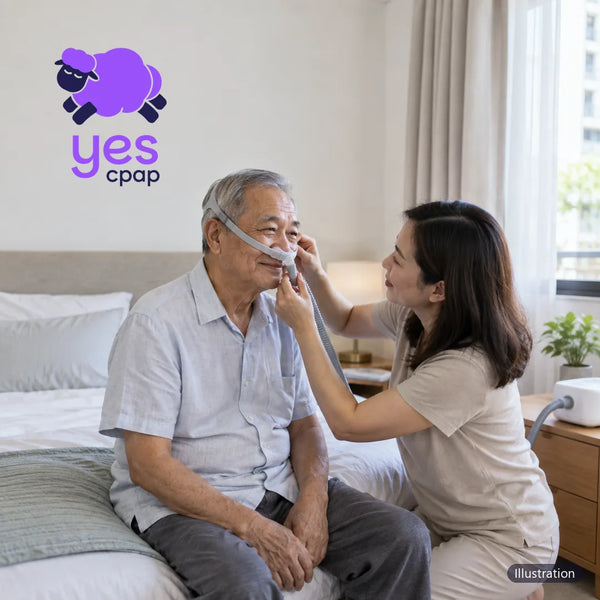
CPAP Machine for Elderly Parents: A 4-Check Buying Guide
Four checks before you buy a CPAP for a diagnosed parent in Singapore: the doctor's plan, easy controls, a magnet-free mask and...
CPAP Rental Singapore: Rent or Buy? A 2-Minute Break-Even Guide
Renting a CPAP only beats buying for a short trial. Divide the machine price by the monthly rent to find your break-even...
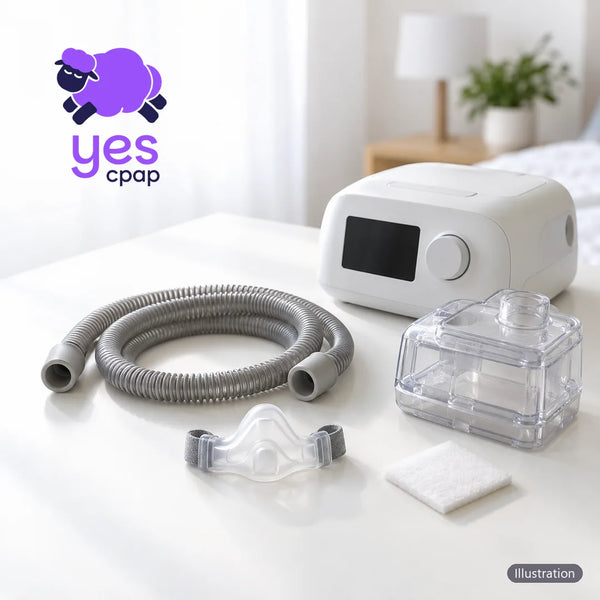
How Long Does a CPAP Machine Last? 4 Signs It Is Time
Your CPAP's manual, not an online average, says when to replace it: 10 years for Resvent's iBreeze CPAP models, 5 for the...